Tutorial 1: Built in demonstration scripts
[1]:
# import dlim packages
from dlim.model import DLIM
from dlim.dataset import Data_model
from dlim.api import DLIM_API


import pandas as pd
import matplotlib.pyplot as plt
from scipy.stats import pearsonr
from numpy.random import choice
Load data and split the data into training and validation
Load data, data needs to be a csv file
the first n-1 columns n-1 genes or different variable, in each genes, there will be multiple mutations
the last column is fitness value
[2]:
df_data = pd.read_csv("./data/data_epis_1.csv", sep = ',', header = None)
Load data into tensor format and feed to DLIM later on
Manually split data into 70% for training and 30% for testing
[ ]:
data = Data_model(data=df_data, n_variables=2)
train_id = choice(range(data.data.shape[0]), int(data.data.shape[0]*0.7), replace=False)
val_id = [i for i in range(data.data.shape[0]) if i not in train_id]
train_data = data.subset(train_id)
val_data = data.subset(val_id)
Construct your model and train your data
DLIM model: - n_variables: the number of variables (e.g., genes, environments) - hid_dim: the number of neurons in hidden layers - nb_layer: the number of hidden layers of your NN
DLIM_API:
this is the api to train, predict and plot the final landscape obtained
model: DLIM model
flag_spectral: bool, True if use spectral initialization; False, use Xavier-Glorot initialization
dlim_regressor.fit: train the model with training data
Hyperparameters
lr: learning rate
nb_epoch: number of epoches
batch_size: size of batch
emb_regularization: weight on regularization on embeddings
save_path: path for saveing model, if None, the model won’t be saved
[15]:
model = DLIM(n_variables = train_data.nb_val, hid_dim = 32, nb_layer = 1)
dlim_regressor = DLIM_API(model=model, flag_spectral=True)
losses = dlim_regressor.fit(train_data, lr = 1e-3, nb_epoch=40, batch_size=32, emb_regularization=0, \
                            save_path= './pretrain/harry_epis_model.pt')
spectral gap = 0.865142822265625
spectral gap = 0.568690836429596
Model saved to ./pretrain/harry_epis_model.pt
Show the learning loss during training
[16]:
plt.figure
plt.plot(losses)
plt.show()

Prediction on validation data
dlim_regressor.predict
data should be tensor
detach: bool, True to get numpy array type output; False, get tensor type output
[11]:
fit_a, var_a, lat_a = dlim_regressor.predict(val_data.data[:,:-1], detach=True)
Visualization on landscape
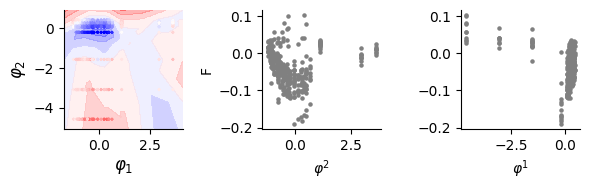
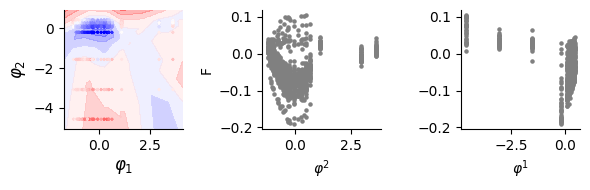
first panel: landscape by DLIM and dots are measurements
second panel: the infered phenotype of each mutations on gene 1 versus all fitness mesured on this mutation
third panel: the infered phenotype of each mutations on gene 2 versus all fitness mesured on this mutation
[12]:
score = pearsonr(fit_a.flatten(), val_data.data[:, [-1]].flatten())[0]
print(score)

fig, (bx, cx, dx) = plt.subplots(1, 3, figsize=(6, 2))
dlim_regressor.plot(bx, data)

for xx in [bx, cx, dx]:
    for el in ["top", "right"]:
        xx.spines[el].set_visible(False)

# Plot the a00verage curve
print(pearsonr(lat_a[:, 0], val_data[:, -1]))
cx.scatter(lat_a[:, 0], val_data[:, -1], s=5, c="grey")
dx.scatter(lat_a[:, 1], val_data[:, -1], s=5, c="grey")
cx.set_ylabel("F")
cx.set_xlabel("$\\varphi^1$")
dx.set_xlabel("$\\varphi^2$")
plt.tight_layout()
plt.show()
0.9723149104776725
PearsonRResult(statistic=-0.010524778629337813, pvalue=0.8407427503016924)
Use pretrained model
DLIM model: - n_variables: the number of variables (e.g., genes, environments) - hid_dim: the number of neurons in hidden layers - nb_layer: the number of hidden layers of your NN
DLIM_API:
if the model is already saved, you can load the model by add
load_model: the path of the saved model
flag_spectral: bool, True if use spectral initialization; False, use Xavier-Glorot initialization
dlim_regressor.predict: use saved model to predict data
[13]:
model = DLIM(n_variables = data.nb_val, hid_dim = 32, nb_layer = 0)
dlim_regressor = DLIM_API(model=model, flag_spectral=True, load_model='./pretrain/harry_epis_model.pt')
fit_a, var_a, lat_a = dlim_regressor.predict(data.data[:,:-1], detach=True)
Visualization of obtained landscape
[14]:
score = pearsonr(fit_a.flatten(), data.data[:, [-1]].flatten())[0]
print(score)

fig, (bx, cx, dx) = plt.subplots(1, 3, figsize=(6, 2))
dlim_regressor.plot(bx, data)

for xx in [bx, cx, dx]:
    for el in ["top", "right"]:
        xx.spines[el].set_visible(False)

# Plot the a00verage curve
print(pearsonr(lat_a[:, 0], data[:, -1]))
cx.scatter(lat_a[:, 0], data[:, -1], s=5, c="grey")
dx.scatter(lat_a[:, 1], data[:, -1], s=5, c="grey")
cx.set_ylabel("F")
dx.set_xlabel("$\\varphi^1$")
cx.set_xlabel("$\\varphi^2$")
plt.tight_layout()
plt.show()
0.9763892968817973
PearsonRResult(statistic=0.03691106761164796, pvalue=0.19706734038768178)
[ ]: